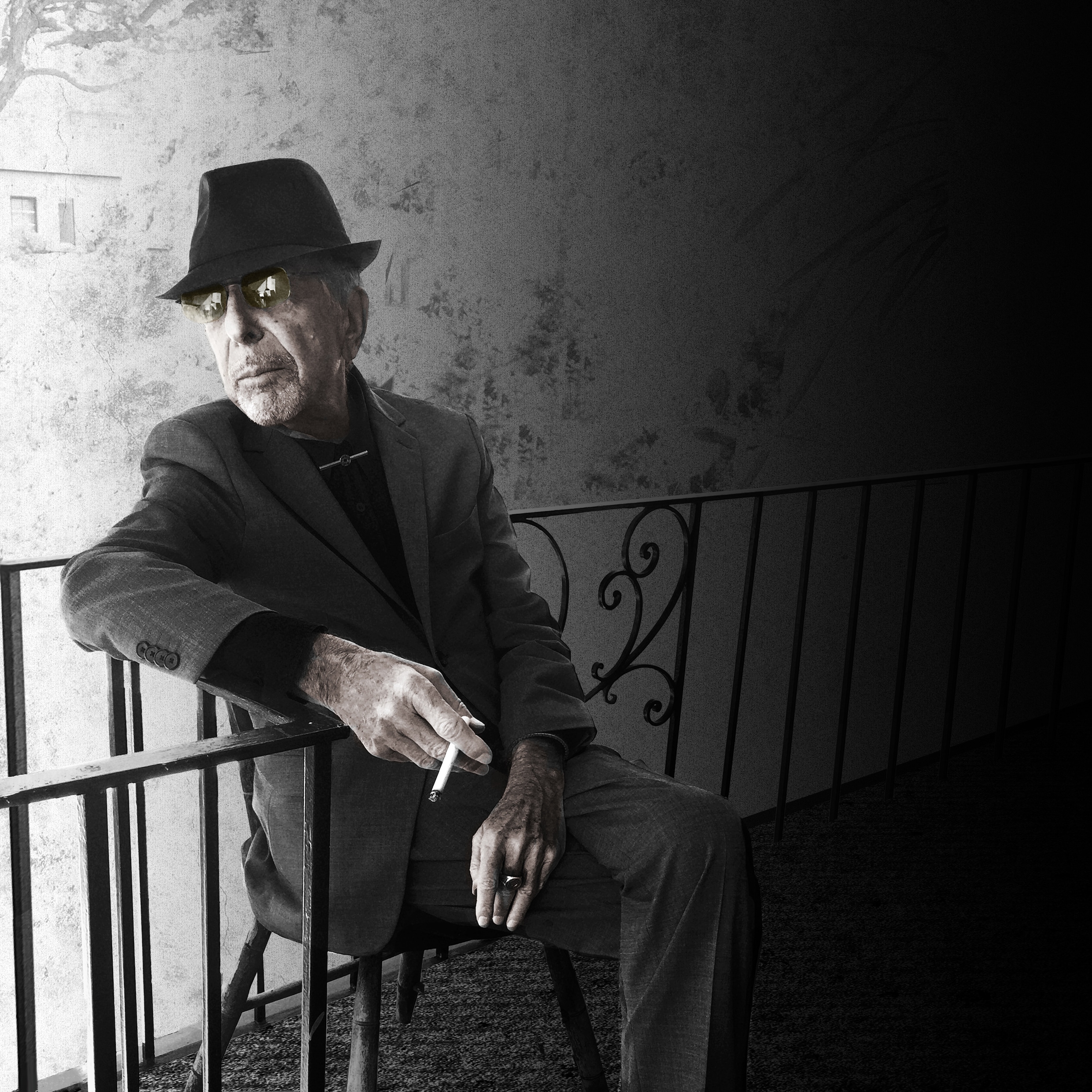
Leonard Cohen died in November of 2016, a mere few weeks after the release of his last record, You Want it Darker. The homonymous song of that record greatly surprised me, and revealed to me a Leonard Cohen that I was previously unaware of.
When I like the art produced by an artist, I tend to confine my interest to the art, rather than the artist. I guess I learned this lesson as a teenager, in the early nineteen-eighties, from the first book I ever bought, using my own pocket money: No One Here Gets Out Alive, the life and death of Jim Morrison. Contrary to my expectations, once I was done reading the book I decided that there was really nothing to take home from it. This, then, became a broader theme throughout my life: I have always been very weary of cults of personality and I will almost never state that I am a fan of anyone.
I say almost never, because proclaiming that nobody is worthy of admiration shows lack of appreciation for some undeniably great humans, and depending on how you mean it, it constitutes either hubris or nihilism.
So, I may, on a rare occasion, call myself a fan of someone. However, I only do so posthumously, because it is only after someone's death that we can be sure that they will not do anything stupid to disappoint us.
This is, for example, why I can say with confidence that I am a fan of Bertrand Russel, while I never said that I am a fan of Elon Musk, no matter how much I liked the guy. (And recent developments vindicate my choice amply, to say the least.)
Also, Richard Dawkins has certainly earned his laurels, but technically he is on my waiting list for as long as he is still breathing. (And in case you are wondering, no, his recent brushes with the wokes, regarding exactly how many sexes exist, which nearly resulted in him being cancelled, did not change my opinion about him at all; if anything, I have even more respect for him now.)
So, the way it went with Leonard Cohen is that I have always liked his music, but I have known very little about the man.
I have known him as Canadian, but that is the most basic thing you can know about someone.
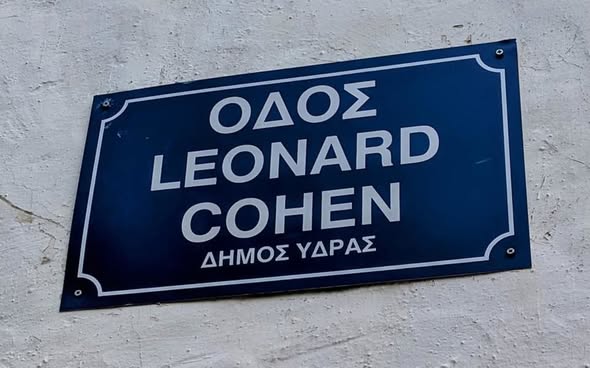
I have known that he owns a home on the island of Hydra, where he spent a part of his life, but that is something that you cannot fail to know about him if you are Greek.
I have known that he is Jewish, but I have not known whether he identified as such by religion, or by heritage, or just by upbringing environment. Furthermore, I have not sought to clarify this, because I would rather leave his personal life alone.
I have known him as a leftist, but there are many examples of leftists who were to some degree religious.
I have known him as being anti-establishment, but I had no idea whether he considered god as part of the establishment.
I have known that he makes some religious references in his songs, but I did not have any grounds to doubt the sincerity of the references.
So, from all that I knew about him, I had no reason to suspect that he had any beef whatsoever with religion, or with god in particular.
When I discovered the song You Want it Darker on YouTube I started playing it in the background, intending to do other things while listening to it, but as soon as I realized what the lyrics were saying I jumped in my seat. I listened to it again. And again. I found the lyrics and read them. To my astonishment, I realized that the song was a fierce condemnation and rejection of the Judeo-Christian god.
The criticism in the song is not directed only towards organized religion, or only towards its followers; it is also largely directed to god himself: it is personal. And it is not just a denial: it is anathema. The song competes with old favorites of mine like Dear God by XTC, Orgasmatron by Motörhead, and God Was Never On Your Side, also by Motörhead. I cannot imagine a more poetic way of telling god to, uhm, basically, fuck off.
Acknowledging the fact that Leonard Cohen's lyrics were often enigmatic, and the fact that we tend to interpret enigmatic lyrics according to our own belief systems, I searched around for more information about the song, trying to find out what others are saying about it. Sure enough, various folks interpret the song in whatever way suits their prejudices. I found a religious web site where someone explains the song as an affirmation of Leonard Cohen's faith; so, that person listened to the same song that I listened to, and yet took home from it the exact opposite of what I took home. Great, just great.
Clearly, there must be ways of interpreting the song that are right, and ways that are wrong; but how can we tell?
Well, according to Wikipedia, Alexis Petridis, the head critic for rock and pop music at The Guardian described the song as "a menacing critique of religion".
But what do critics know, right?
And besides, everyone knows that Wikipedia is unreliable, right?
So, let us look at the lyrics, shall we?
Artist: Leonard Cohen
Song: You Want It Darker (2016)
If you are the dealer, I'm out of the game
If you are the healer, it means I'm broken and lame
If thine is the glory, then mine must be the shame
You want it darker
We kill the flame
Magnified, sanctified
Be thy holy name
Vilified, crucified
In the human frame
A million candles burning
For the help that never came
You want it darker
Hineni, hineni
I'm ready, my Lord
There's a lover in the story
But the story's still the same
There's a lullaby for suffering
And a paradox to blame
But it's written in the scriptures
And it's not some idle claim
You want it darker
We kill the flame
They're lining up the prisoners
And the guards are taking aim
I struggle with some demons
They were middle class and tame
I didn't know I had permission
To murder and to maim
You want it darker
Hineni, hineni
I'm ready, my Lord
Magnified, sanctified
Be thy holy name
Vilified, crucified
In the human frame
A million candles burning
For the love that never came
You want it darker
We kill the flame
If you are the dealer, let me out of the game
If you are the healer, I'm broken and lame
If thine is the glory, mine must be the shame
You want it darker
Hineni, hineni
Hineni, hineni
I'm ready, my Lord
For those who read the lyrics above and are still unsure, here is an explanation of it all, verse by verse, courtesy of yours truly. Of course, my interpretation may be subject to my own prejudices, so please, by all means, leave a comment and tell me where you think I am wrong.
If you are the dealer, I'm out of the game
If you are the healer, it means I'm broken and lame
If thine is the glory, then mine must be the shameThese verses constitute outright denial of god: whatever it is that god stands for, Leonard Cohen wants to have nothing to do with it. A reference is also being made to the biblical significance of repeating something three times as signaling a decree that is fully settled and impossible to ignore.
You want it darker
We kill the flameThese verses can be interpreted as saying that religion demands a worsening of the human condition, and its followers seem to be happy to abide to the absolute degree. The flame may allegorically refer to religion's historical opposition to enlightenment, the inescapable conclusion being that religiosity necessarily implies a dumbing down of the world. In this sense, the flame is the same as the one mentioned by another favorite Jew of mine in his own famous scathing critique of superstitious belief: The Demon-Haunted World (Science as a Candle in the Dark) by Carl Sagan. The light may also be a reference to the singer's own impending death, by way of that one poem by Dylan Thomas.
Magnified, sanctified
Be thy holy name
Vilified, crucified
In the human frame"Magnified and sanctified be His great name" are the opening words of the Kaddish, a prayer central to Jewish liturgy and entirely absent from the Christian literature. The crucifixion, on the other hand, is an exclusively Christian thing, and entirely absent from the Jewish literature. Thus, these two verses establish a Judeo-Christian perspective, rather than a purely Jewish one or a purely Christian one. Obviously, Leonard Cohen has an axe to grind with both. This becomes important a bit further down.
A million candles burning
For the help that never cameThis points out the folly of going through the motions of worshiping a god who is entirely absent. It also constitutes the first reference in this song of the great philosophical / theological Problem of Evil, otherwise known as the Epicurean Paradox: how is it possible to reconcile the existence of evil and suffering in this world with the notion of a supposedly omnipotent, omniscient, and omnibenevolent god? (Spoiler: it is not possible.)
Hineni, hineni
I'm ready, my LordHineni is a Hebrew word which means "here I am". It is the response given by various important biblical figures, such as Abraham, upon being called by god in various chapters of the bible. In Leonard Cohen's own words, (from the official You Want It Darker press conference,) it is "a declaration of readiness, no matter what the outcome."
There's a lover in the story
But the story's still the sameThe lover is obviously Jesus, since a previous verse established a Judeo-Christian context rather than a purely Jewish one. To say that the story is still the same is to say that the addition of Jesus in the New Testament does not erase the cruelty of the scriptures, nor the cruelty of the god manifested by those scriptures, and it has done nothing to lessen the historical cruelty of the followers.
There's a lullaby for suffering
And a paradox to blameThe lullaby for suffering may refer to the perverse fascination of the Christian religion with guilt to the point of self-torture. The paradox may refer either to the Epicurean Paradox, or to the famously nonsensical concept of the Original Sin.
But it's written in the scriptures
And it's not some idle claimThis is stating that all the perverse, wrongful, and inhuman things written in the scriptures cannot be simply brushed aside, and the religion has to be judged by what its own scriptures say. (If modern legal systems were to actually do that, then all Abrahamic religions would have to be outlawed as criminal organizations for incitement to hatred, racism, violence, mutilation, murder, and genocide, to name just a few of the offenses.)
They're lining up the prisoners
And the guards are taking aimThis is very obviously a reference to the holocaust.
I struggle with some demons
They were middle class and tameThe demons here are probably the conscience of all those who witnessed the holocaust and yet kept minding their own business, allowing it to happen.
I didn't know I had permission
To murder and to maimThis must be a reference to several notable accounts in the bible where god explicitly instructs the Israelites to commit genocide against their neighboring nations.
While researching the song I learned a few details about the circumstances under which it was made, which surprised me all the more. During the last year of Leonard Cohen's life, his deteriorating health severely restricted his mobility; so, the living room of his home was turned into a recording studio to allow him to sing while seated or reclining.
This means that the record was created while Leonard Cohen was fully aware that his end was near.
There is not a shadow of a doubt that when he says "I am ready, my Lord" he is acknowledging his own imminent death.
Now, usually, people on their deathbed do not tend to pick that as the best moment to break ties with god. Or should I say, to burn their bridges with god. Or perhaps, in his particular case, should I say, to napalm-bomb their bridges with god.
So, the making of this song by Leonard Cohen at the very end of his life seems to be the exact antithesis of a death-bed conversion.
Perhaps good old Leonard associated with religion during his life purely out of social interest, (like my own father did,) which may have given people some false impressions, so perhaps he wanted to set the record straight before departing.
He surely did.
In no uncertain terms.
I take my hat off to him.
The man: Leonard Cohen (Wikipedia)
The record: You Want it Darker (Wikipedia)
The song: Yow Want it Darker (Song) (Wikipedia)