Consistently every year for many years now, the Dutch have been ranking #1 in the world in English-as-a-foreign-language proficiency, according to yearly reports by the Education First (EF) organization. (Wikipedia.) I can attest that at least in the Randstad area, almost everyone speaks English, and many do so very fluently.
Nonetheless, there are certain mistakes that the Dutch are somewhat prone to make in English, due to interference from peculiarities of the Dutch language. When this happens, it is called Dutchlish.
Here is a collection of examples of Dutchlish that I have collected over the course of several years of living in The Netherlands.
I will learn you how to skate.
Learn instead of teach
From Dutch leren, which means either to learn or to teach, depending on context.
When you want, we also have it in white.
When instead of if
Apparently because mixing als (=if) with waneer (=when) is also a common mistake in Dutch.
Let's meet at sex.
Sex instead of six
From Dutch zes, which means six. This is not really a common mistake, but I have personally heard it, and I think it is funny enough to deserve including. (Freudian slip? LOL!)
Dear colleagues, hereby the schedule.
Hereby instead of Here is or Hereby I give you.
Because in Dutch, herebij (which means the same as "hereby", and is pronounced very similarly,) can in fact be used alone like that. However, in English, it can't.
We have lot's of bicycle's
In the written word, using apostrophe-'s' to signify plural, whereas in English plural is signified with -'s' alone, and apostrophe-'s' is only used to signify genitive (possessive) case.
Because in the Dutch language, that is in fact how you signify plural. Different language, different rules. As a result, the Dutchies often confuse the Dutch way of writing plural with the English way of writing plural.
I will meet you at the busstop
In the written word, concatenating words that are not normally concatenated in English.
In Dutch it is very common to concatenate words to form new words. That is, for example, how come the Dutch word for Multiple personality disorder is Meervoudigepersoonlijkheidsstoornis. So, to the Dutch, the term bus stop as two separate words looks unnatura; when they see this, they are seized with an overwhelming desire to concatenate the two words into one: busstop. However, this is not a valid thing to do in English.
I swear I can sometimes hear them using concatenated terms like "busstop" even in the spoken word. (Or maybe I am just imagining it?)
Let's have a telco
Telco instead of teleconference.
The Dutch words for telephone and conference are telefoon and conferentie, so the Dutch have every right to create the word telco in their language. The mistake that they sometimes make is using this word when speaking English, because to English speakers, telco generally does not mean anything, and if it was to mean something, that would perhaps be telecommunications company.
Turn on the airco
Airco instead of air-conditioner.
Judging by the fact that the Dutch word for air sounds nothing like air, (it is lucht,) the word airco is probably the result of the Dutch trying to forge a word that was intended to sound English. However, for English-speakers, airco does not mean anything, and if it was to mean something, that would perhaps be airline company. Apparently, the Dutch do not make the connection between "co" and "company", perhaps because in their language the word for company sounds nothing like company; it is bedrijf.
Estimate repair laptop
In titles, word ordering that makes no sense in English.
The Dutch apparently have certain special rules dictating how to write signs, titles, and e-mail subjects: the sentence is first written in its fully spelled out form, and then all the small words are removed. So, the fully spelled-out sentence "the estimate for the repair of the laptop" is "de schatting voor de reparatie van de laptop", and then the title "Laptop repair estimate" is formed by removing all the small words to yield "Schatting reparatie laptop". Unfortunately, the Dutch are prone to follow the same rule when translating to English, yielding "Estimate repair laptop" (or "Estimate laptop repair" at best) which either makes no sense or means something different.
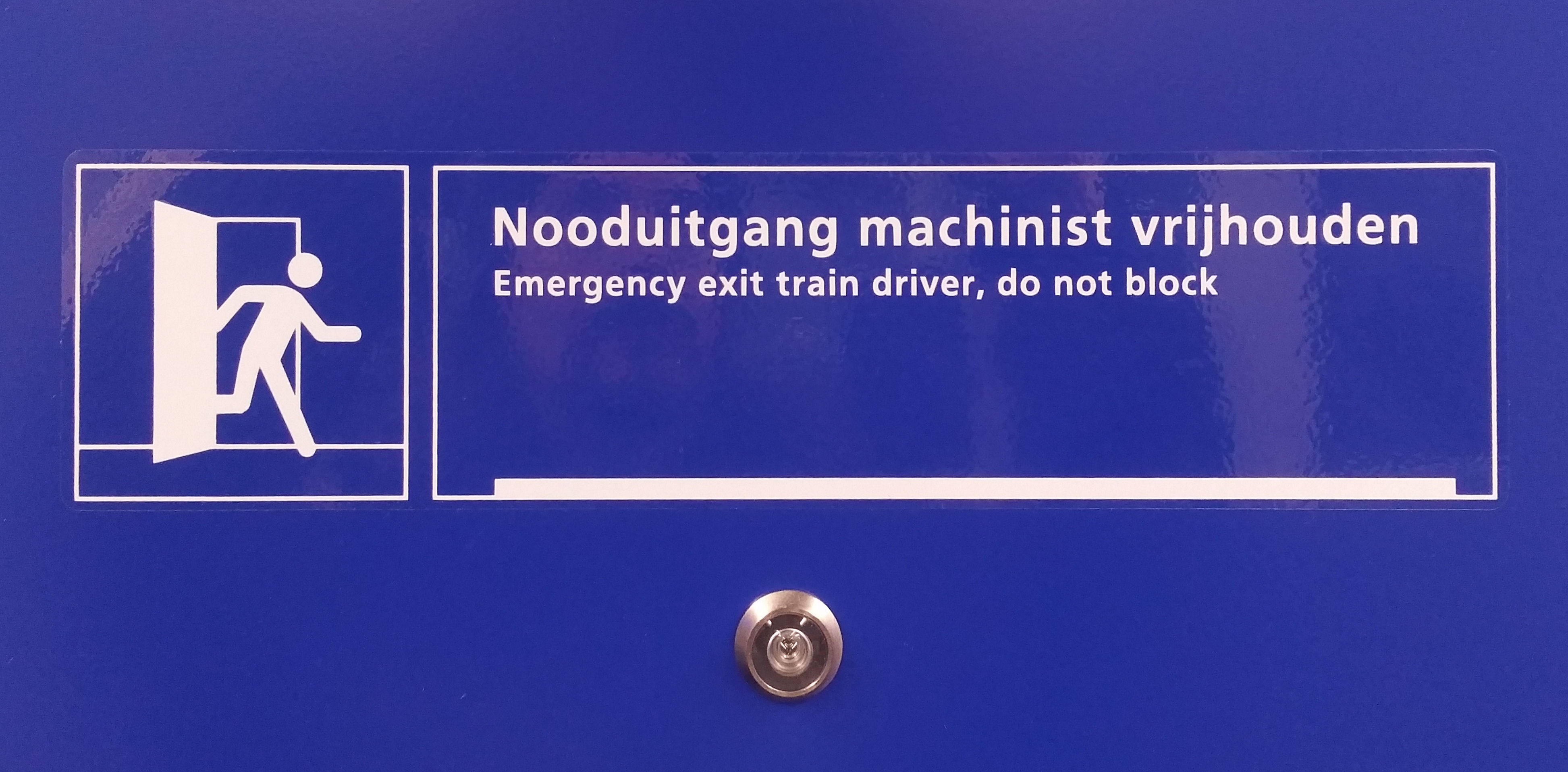
My favorite example of this is a sign that you can see in every single train in the entire little Kingdom of The Netherlands, which urges the passengers to refrain from obstructing the emergency exit of the train driver. The Dutch text says "Nooduitgang machinist vrijhouden" and the English translation says "Emergency exit train driver, do not block". (What?)
 |
|---|
| A sign in Dutch trains, with Dutch text and Dutchlish translation. |
Note how the sentence would be valid not only in Dutch but also in English if the small words had not been omitted:
- Nooduitgang (van de) machinist vrijhouden
- Emergency exit (of the) train driver, do not block.
How long are you?
Long instead of tall.
The Dutch word for high is hoog, and they have no unnecessary extra word like tall. When speaking of a person's height, they do not use the word hoog; but lacking a word like tall, they use the word lang instead, which means long. So, when a Dutch person wants to ask you how tall you are in English, they may inadvertently ask you how long you are instead. (Another Freudian slip? LOL!)
Let's make a photo
Make instead of take for photos.
From Dutch foto maken.
Can I lend your umbrella?
Lend instead of borrow.
From Dutch lenen which means either to lend or to borrow, depending on context.
You want just the bread?
Bread instead of Hamburger.
No, the McDonald's employee is not seriously considering that you might want nothing but a plain piece of bread; what they mean to ask instead is whether you want the hamburger alone, or the entire combo consisting of the hamburger plus fries plus drink. They say "bread" because in their head they are translating word for word from Dutch, where every edible item that is served on bread is referred to as a broodje, which means bread.
Fodafone
In the spoken word, pronouncing the letter V as if it was an F.
Dutch pronunciation rules tend to cause some weird things to happen; for example, when you call Vodafone in The Netherlands, the recorded greeting welcomes you to "Fodafone". Here I have recorded two such greetings, one from sales, one from billing:
This is due to some weirdness in how the letter V sounds in the Dutch language. A similar weirdness also exists in German; if you are an English speaker, chances are you have always pronounced Volkswagen wrongly; the correct pronunciation is folks-vaa-gen.
However, the use of Dutch pronunciation rules is questionable when it comes to the names of companies originating outside of The Netherlands, such as Vodafone, which hails from the UK.
Tax for Taxi
Using the word "tax" in reference to "taxi", which does not quite work in English.
Naturally, taxi firms all over the world tend to want to do their best to communicate in English, because their clients are often tourists, and the international language of tourism is English. It is surprising then, that many taxi companies in The Netherlands use "tax" to mean "taxi".
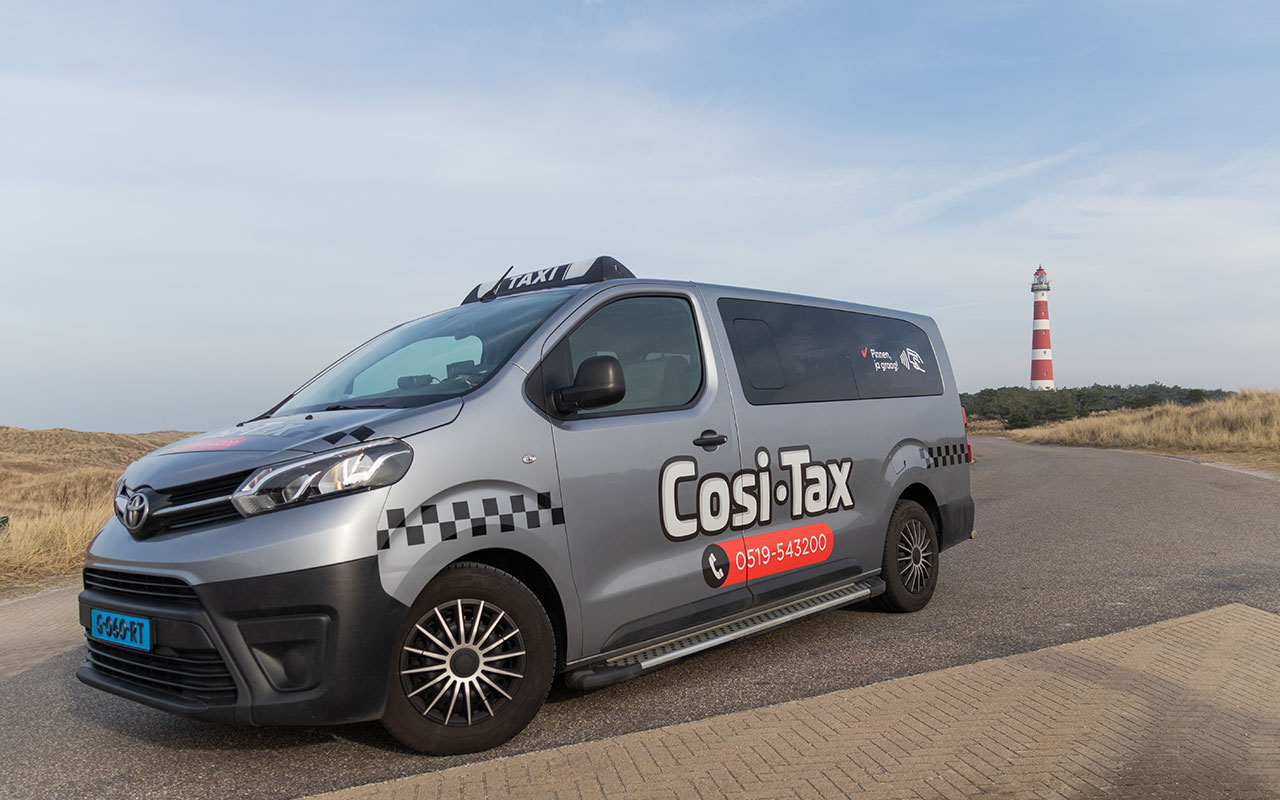
Here is an indicative list of Dutch domain names that belong to taxi firms: my-tax.nl; atax.nl; btax.nl; t-tax.nl; v-tax.nl ahrotax.nl; cosi-tax.nl; ataxeindhoven.nl; eagletax.nl; star-tax.nl; and my personal favorite, city-tax.nl. The list is practically endless. Apparently, many Dutchies are under the impression that the word "tax" evokes the notion of "taxi" in English, but that is not so; in the English-speaking world, all these domain names would belong to accounting firms. (And fun fact: in Europe, another name for "city tax" is "tourist tax"; probably not an association you want to be making if you are a taxi service.)
I used to think that perhaps this is happening because the Dutch word for tax sounds nothing like "tax", it is belasting, so maybe they do not associate "tax" with taxation, but according to the Dutch dictionary, the word tax also exists in the language, and is indeed a financial term, and is in fact related to taxation. So, how come the Dutch feel free to use "tax" to stand for taxi, is beyond me.
Another fun fact: The word taxi is a shortening of the word taxicab. The word taxicab is a contraction of the term taximeter cabriolet. Cabriolet is a type of light, horse-drawn carriage. Taximeter is a blend of Greek metron (measure) and Latin taxa, which means fee, or charge, or charging a fee. So, albeit very remotely, "taxi" is in fact related to "tax" in English. The Dutch are not entirely wrong on this one, after all!
Cover image: "Dutch Tongue" by michael.gr, based on the logo of The Rolling Stones and the Flag of the Kingdom of the Netherlands.